Layered AI
A modular, progressive-disclosure chat interface that helps self-directed learners manage cognitive overload by transforming AI responses into hierarchical, explorable outlines.
Overview
Layered AI is a modular, progressive-disclosure chat interface that helps self-directed learners manage cognitive overload by transforming AI responses into hierarchical, explorable outlines.
The project was completed at UC Berkeley’s School of Information as part of the UX for AI course.
Challenge
How do individuals experience the shift from tangled, unclear thoughts to clear understanding when learning new concepts?
Through user interviews with 4 graduate students and professionals experiencing daily cognitive overload, we identified three core problem spaces:
- Structure without a framework — People struggle to craft personalized learning processes and create their own structure when no formal framework exists.
- Authentic learning vs. productivity pressure — People want to learn for joy and personal growth while maintaining their authentic voice, but feel pressure to make everything productive and achievement-oriented.
- Blind spots and feedback gaps — Learners can’t reliably see their blind spots or get timely, non-judgmental feedback aligned to their goals, leading to false confidence, shallow understanding, and plateaus.
My Role
UX Researcher conducting stakeholder interviews, qualitative analysis through affinity mapping, competitive analysis, storyboarding, and usability testing.
Process
Story Mapping
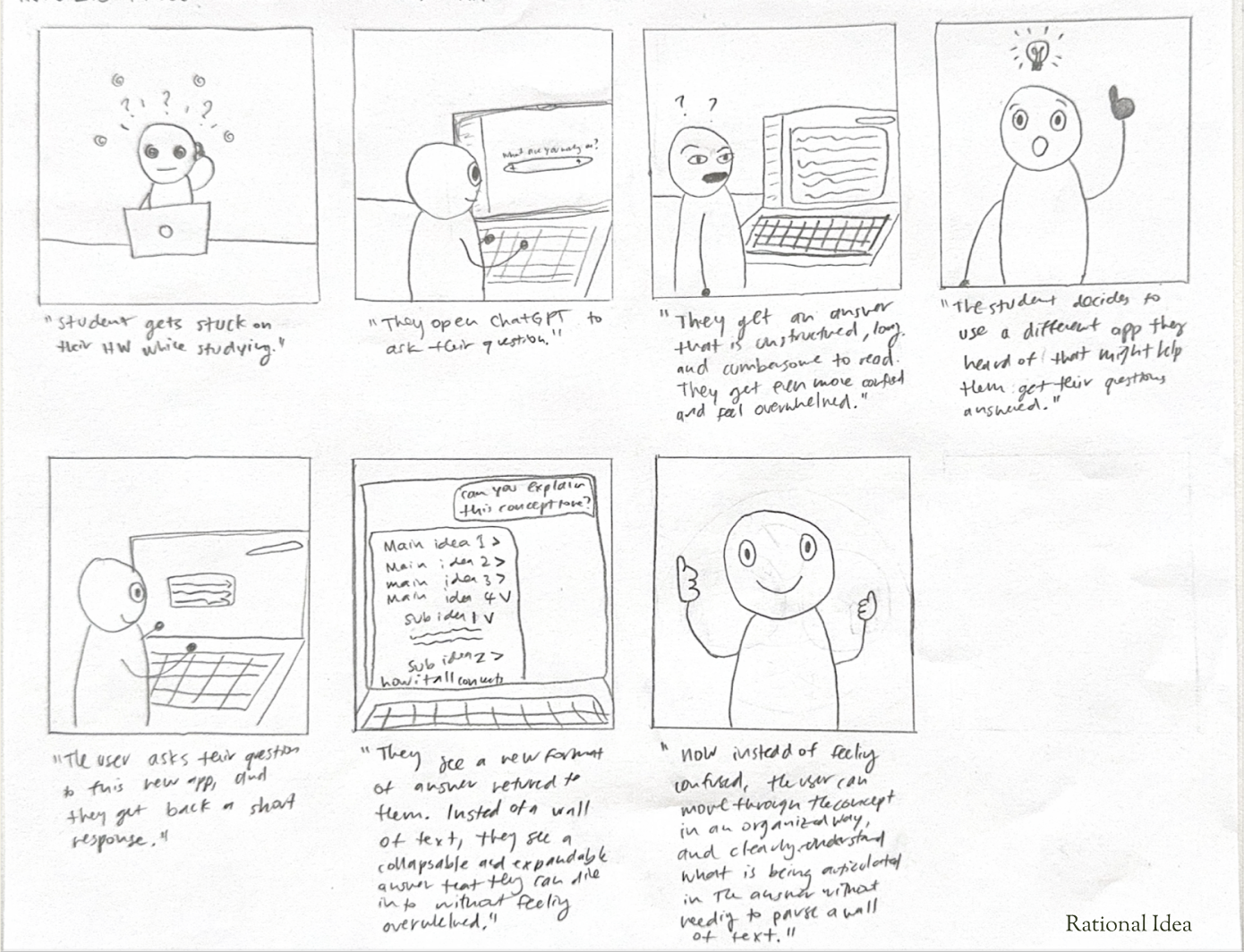
We mapped the learner journey from “overwhelm and disconnection” to “confident understanding and authentic expression,” surfacing the key friction points and opportunities across each stage.
Golden Path
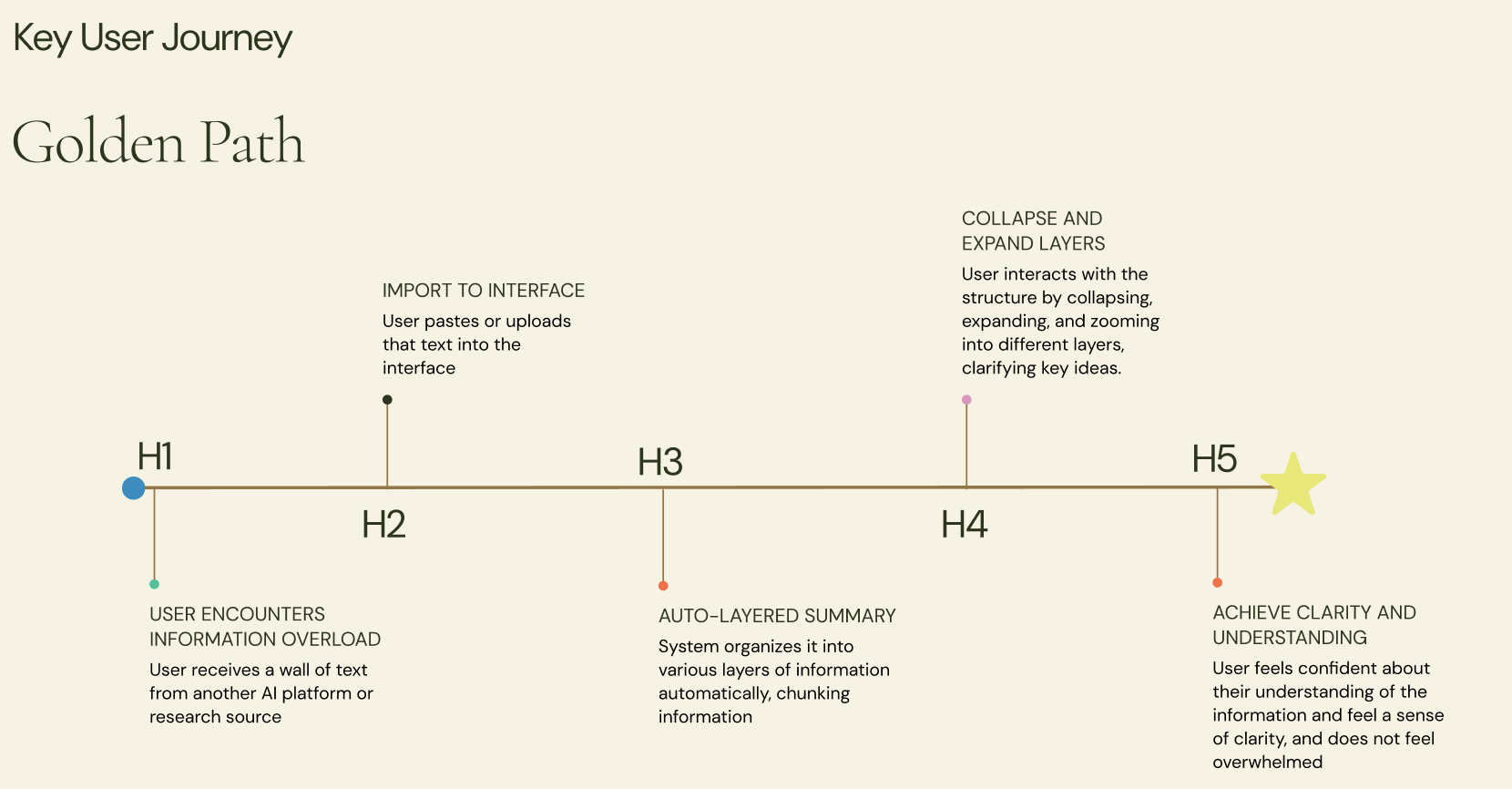
From the story map, we identified the golden path — the ideal end-to-end flow a learner would take through the product to move from confusion to clarity.
Competitive Analysis
Perplexity AI — Closest on intent (reduce overload; cite sources). It chunks info, links sources, and includes a related questions section — yet lacks true hierarchical collapsibility and node-level evidence binding.
Notion — Allows users to organize and summarize information into collapsible sections or nested pages, offering a hierarchical structure similar to the layered interface concept. However, its structure is largely manual and productivity-focused rather than automatically generated for cognitive clarity.
Additional competitors analyzed: Notion AI, Duolingo Max, Tana, Pinterest, Miro.
Prototypes
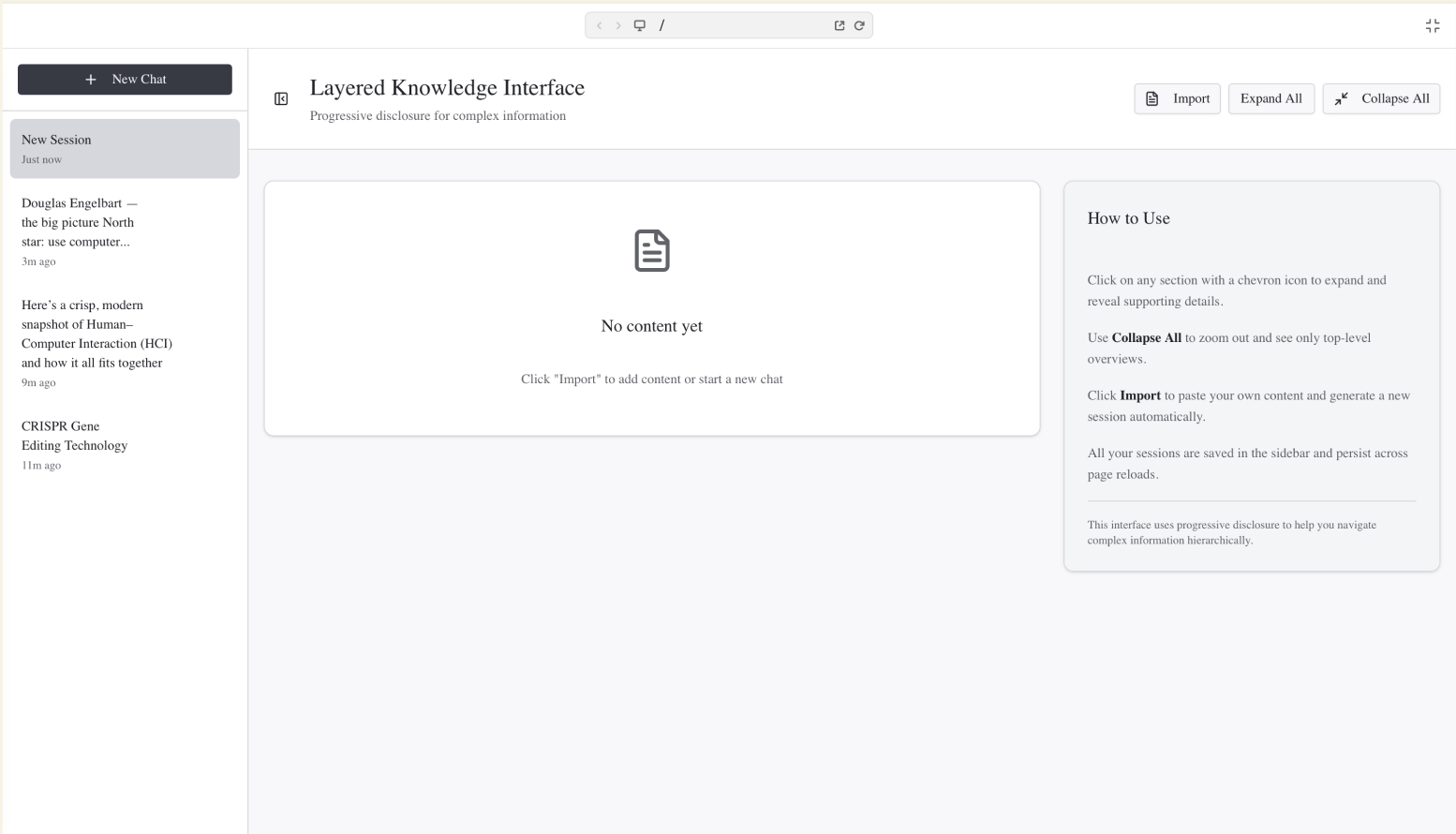
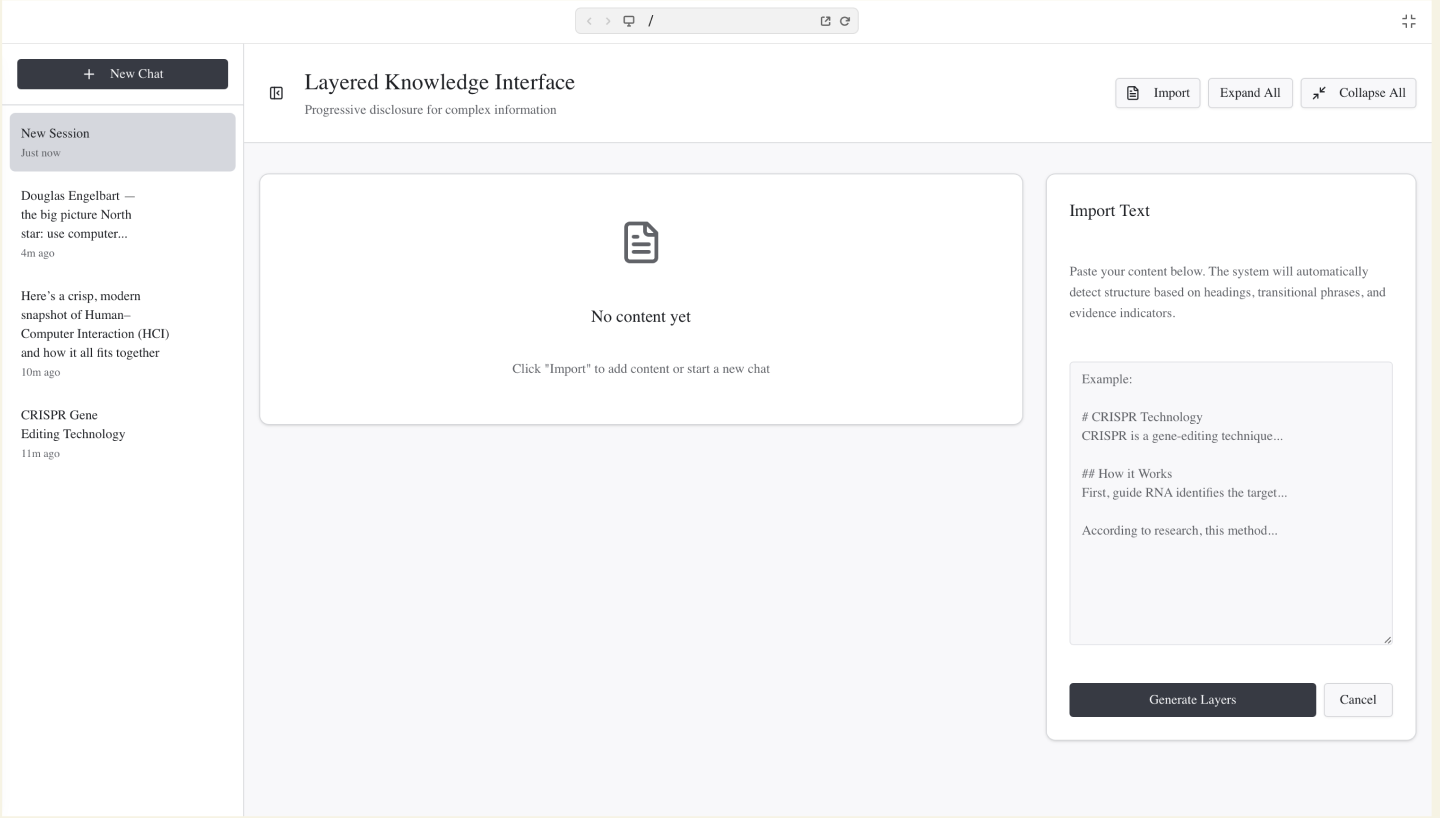
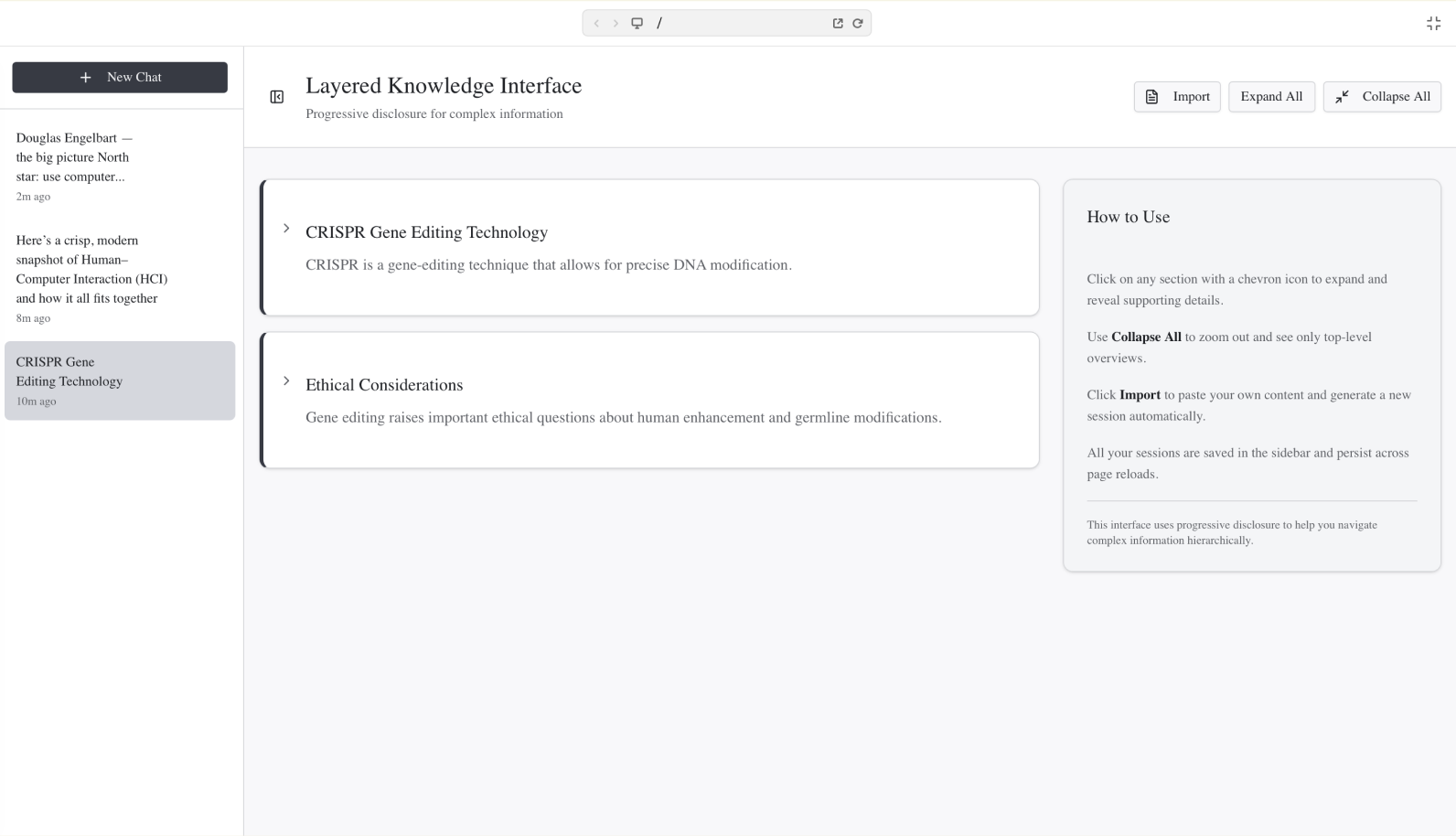
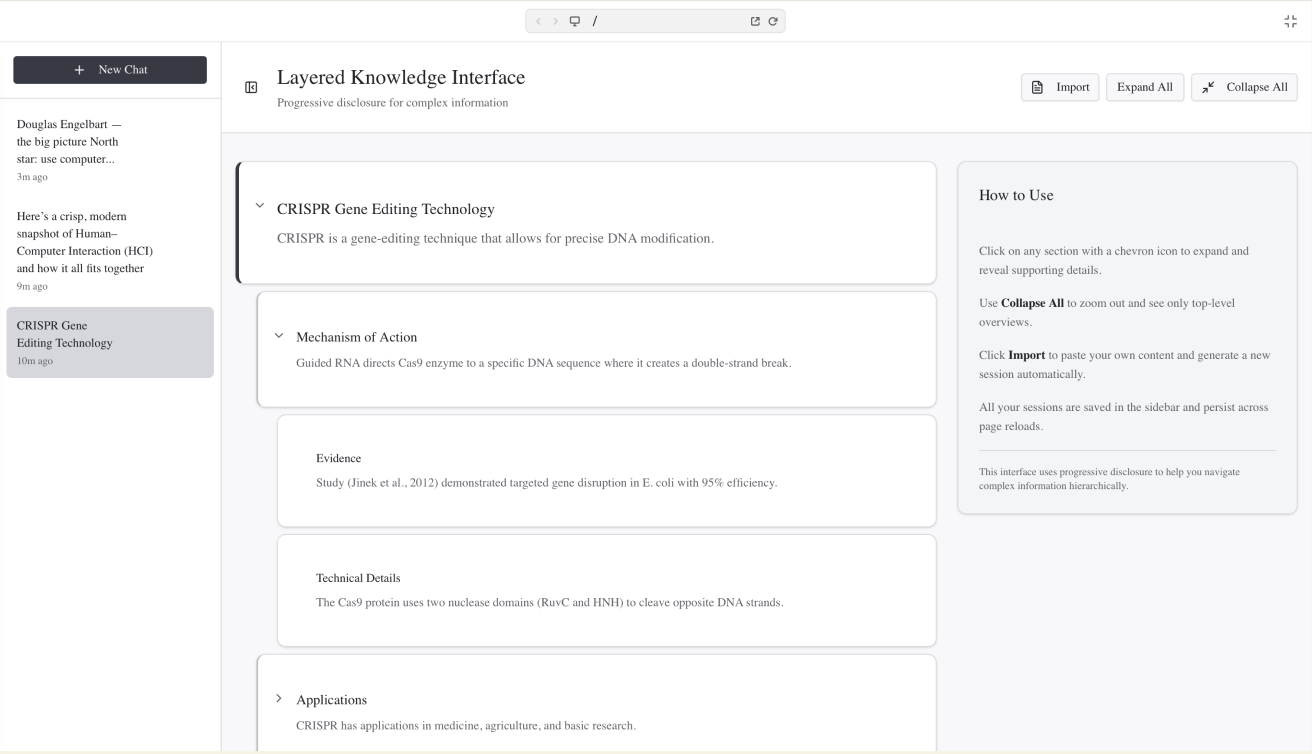
We brainstormed and prototyped three solutions targeting different learning stages, then tested low-fidelity prototypes with 5 participants (ages 21–25, all daily learners).
Usability Testing
Background Interview
We opened each session with questions to understand how participants currently use AI tools and where friction arises.
How often do you use AI chat tools?
The participant uses multiple AI tools for different purposes:
- ChatGPT — coding, voice feature, and discussion/communication practice
- Perplexity — research with deep references (e.g., understanding political dynamics)
- Claude — research documentation and better structure
What feels overwhelming or confusing when reading AI responses?
- Poor initial results requiring iteration — Participant often receives unsatisfactory results and needs to deep dive; all tools are dependent on prompt quality
- Inaccurate or outdated information — A recurring concern across tools
What helps you process complex information in long answers?
Setting output constraints — Participant prompts AI to limit response length (specific number of characters or lines). Example: when writing bug reports, AI gives complicated answers, so the participant asks to simplify.
Usability Tasks
Task 1: Expanding and Collapsing Layers
Goal: See if users understand progressive disclosure.
After entering a topic, the participant received layered results and was clear on the expand functionality, understanding the different modules presented. However, they noted the language in the results felt complicated — indicating that content complexity, not just interface structure, presented comprehension challenges.
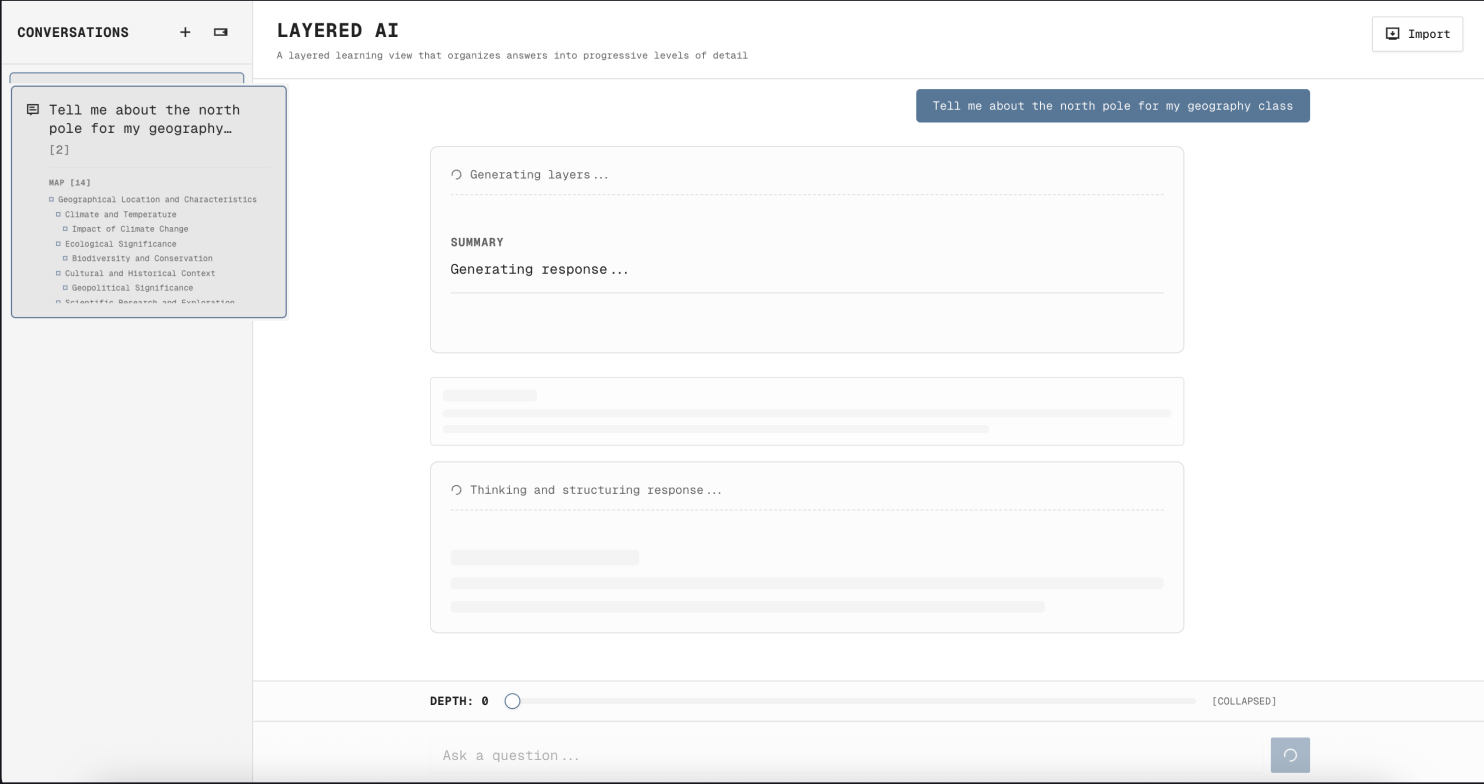
Task 2: Adjusting Information Depth
Goal: Test understanding of the global zoom / information depth slider.
The zoom control was initially unclear — the participant was uncertain what the functionality did when first encountered, suggesting the control label or affordance needs refinement.
Debrief
What did you like most about the interface?
- Design is clean and simple, not cluttered
- Can see all options directly upon viewing
- Aligns with existing mental models for AI tools
Would you prefer this over a normal chat interface?
- Good for learning new things because it organizes content with clear headings
- Effective for exploring a new topic at your own pace
- Suggestion: responses could be more detailed within each layer
Solution
Layered AI — a modular, progressive-disclosure chat interface that manages cognitive load by letting users control abstraction level, explore ideas chunk-by-chunk, and see the structure of explanations without being crushed by text.
Results
- All 5 participants chose Layered AI as the “only one that consistently reduced overwhelm”
- Participants described it as their “learning mode” for AI — making learning calmer, helping them avoid getting lost in walls of text, and enabling step-by-step understanding
- Successfully addressed information overload through progressive disclosure and user-controlled depth, allowing learners to navigate from confusion to clarity at their own pace